
A safe night's volume, by NIOSH's own standard, is 85 dB averaged over 8 hours, and most club and festival sets run well past that. The fix isn't playing quieter. It's wearing the right protection, set up the right way, so you can still hear your own mix. This piece covers what the limit actually means, which earplugs preserve fidelity instead of muffling it, and why an in-ear monitor isn't automatically a safe one.
What counts as a dangerous volume in the booth
NIOSH's recommended exposure limit (REL) is 85 A-weighted decibels (dBA) averaged over an 8-hour shift. That number isn't a cliff edge. NIOSH applies a 3 dB exchange rate: for every 3 dB the level climbs, the safe exposure time is cut in half. Go from 85 dBA to 88 dBA and your safe window drops from 8 hours to 4. Push to 100 dBA, and the math gets ugly fast.
A peak-hour set rarely sits at 85 dBA. Headline slots and packed floors commonly land in the same range as concerts and headphones at max volume, 94 to 110 dBA. At that range, the safe exposure window is measured in minutes, not a full set length. A four-hour closing slot at festival volume isn't a judgment call. By NIOSH's own exchange rate, it's already past the line.
How loud a set actually gets
A few reference points make the scale concrete. Normal conversation sits at 60 to 70 dBA. Concerts, sporting events and headphones at full volume run 94 to 110 dBA. The WHO's safe-listening duration table puts this in weekly terms:
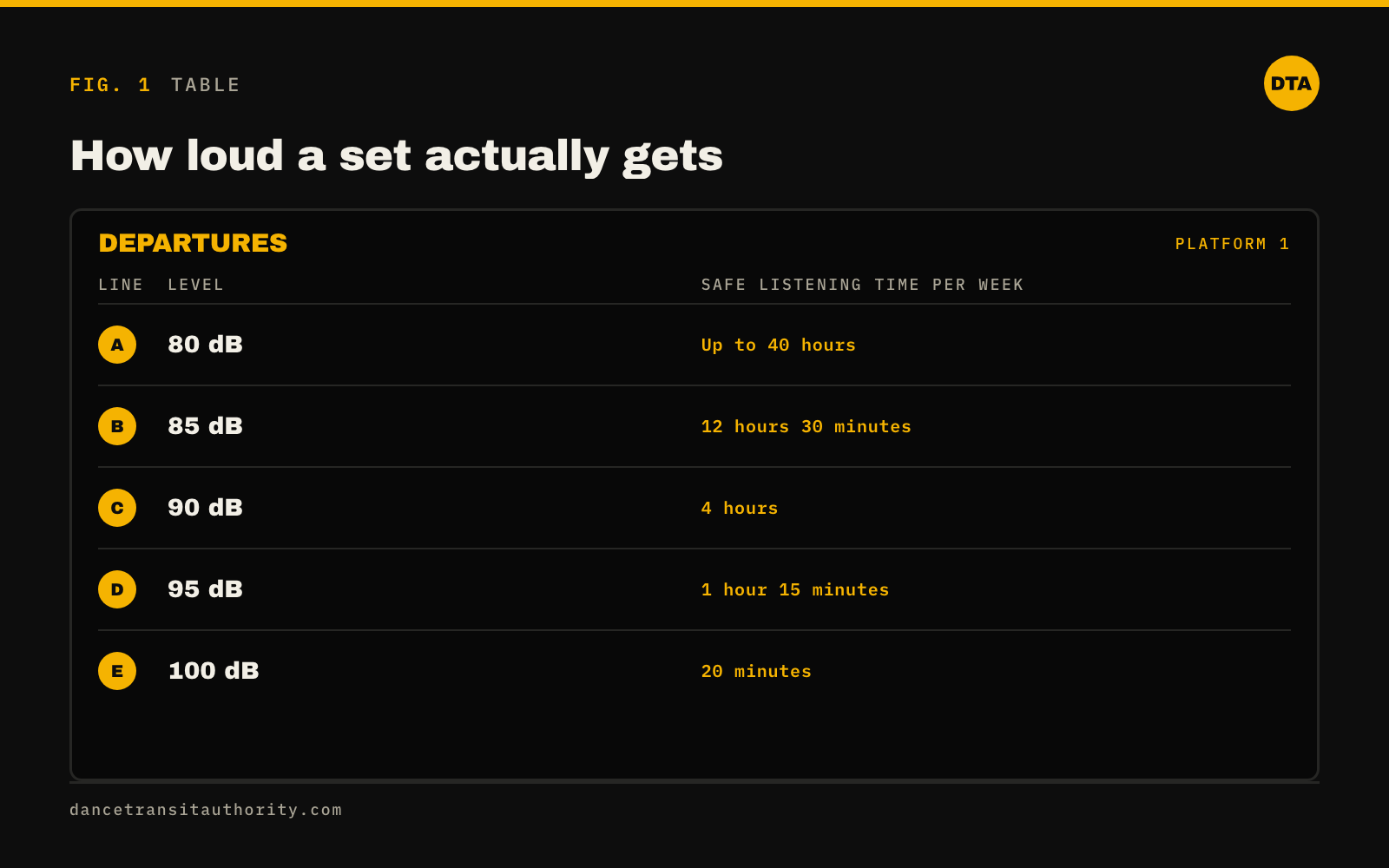
| Level | Safe listening time per week |
|---|---|
| 80 dB | Up to 40 hours |
| 85 dB | 12 hours 30 minutes |
| 90 dB | 4 hours |
| 95 dB | 1 hour 15 minutes |
| 100 dB | 20 minutes |
Notice how fast the safe window shrinks. A single festival weekend at 95 to 100 dBA can burn through a month's worth of safe exposure in one night.
Here's the tricky part: damage doesn't always announce itself. Noise-induced hearing loss (NIHL) can feel temporary at first: hearing seems to recover within 16 to 48 hours of a loud show. That recovery feeling is misleading. The underlying damage is cumulative, and NIHL is permanent once it sets in, even though it's also completely preventable with the right habits.
Volume is only one variable. NIDCD frames the risk as a function of three things together: how loud, how close and how long. Standing next to a monitor wedge or a subwoofer stack raises your real exposure well above what a room-average reading would suggest, even if the number on a phone app looks tolerable from the dance floor. Where you stand for four hours matters just as much as what the system is putting out.
Picking earplugs that do not kill the mix
Not all earplugs protect the same way, and the difference matters if your job depends on hearing the mix accurately.
Foam earplugs are cheap, meant for one-time use, and reduce high frequencies more than low ones, which is why a loud room through foam plugs sounds muffled rather than just quieter. Flat-attenuation earplugs, often sold as "musicians' earplugs," reduce volume evenly across frequencies, closer to turning down a fader than throwing a blanket over the speaker. NIOSH specifically flags these as the better pick when high-fidelity sound or spoken communication matters, which describes a working DJ booth exactly.
The noise reduction rating (NRR) printed on the box is a ceiling, not a guarantee. NIOSH notes that the labeled NRR often doesn't reflect the actual protection a given person gets, and recommends derating it. The only way to know your real attenuation is individual fit testing, which produces a Personal Attenuation Rating (PAR) specific to you and that exact protector.
One more threshold worth knowing: once ambient noise hits 100 dBA or more, NIOSH recommends double protection, earmuffs worn over earplugs. Outside of that extreme, aim to land in a 75 to 85 dBA range at the ear: enough reduction to be safe, without cutting you off from the room.
The plug itself comes in a few physical formats worth knowing by name. Formable foam plugs are meant for one-time use but can be reused while they're still clean and still fully expand. Pre-molded plugs are rigid and reusable, made from plastic, rubber or silicone, and the high-fidelity versions are the ones built for flat attenuation. Canal caps hold a formable or pre-molded tip in place on a stiff band you can wear around your neck between sets, which solves the problem of losing a plug in a dark booth. Custom musician earplug molds sit at the top end: fitted to your own ear canal, built for flat attenuation, and priced accordingly.
In-ear monitors are not automatic protection
A sealed in-ear monitor (IEM) looks like hearing protection, but the protection it provides depends entirely on the level you dial in. Push an IEM hot enough to cut through a loud room and it delivers that same harmful level straight to your eardrum, with no safety margin built in just because the device sits inside your ear.
The same safe-listening habits that apply to personal audio devices apply here. WHO guidance recommends keeping volume near 60 percent of maximum, using well-fitted monitors so you're not compensating for sound leaking in around the seal, and taking listening breaks between sets rather than running hot for hours straight. Reaching for more volume every few songs is the signal to fix the seal or the mix, not the gain.
A simple booth checklist
- Know roughly what range the room runs: an opening slot and a packed peak hour are not the same exposure.
- Default to flat-attenuation (musicians') earplugs, not foam, if you need to track the mix closely.
- Treat the printed NRR as a ceiling. A fit test gives you your actual number.
- Double up (earmuffs over earplugs) once the room is at 100 dBA or louder.
- Set IEM volume for safety first, loudness-to-cut-through second, and take breaks between back-to-back sets.
By the DTA editorial desk. Facts checked October 2026. General information, not legal, tax or medical advice: see our disclaimer.
Frequently asked questions
What decibel level is safe for DJs to play at?
NIOSH's recommended exposure limit is 85 dBA averaged over 8 hours, and for every 3 dB above that, the safe exposure time is cut in half, so a loud peak-time set at 97 to 100 dBA is only safe for minutes, not hours.
Do in-ear monitors protect your hearing?
Not automatically. An IEM seals the ear canal, but the protection depends entirely on the volume you set; dial it up to cut through a loud room and it delivers harmful sound directly to your eardrum.
What is the difference between foam earplugs and musicians' earplugs?
Foam earplugs cut high frequencies more than low ones, which muffles the mix, while flat-attenuation musicians' earplugs reduce all frequencies evenly, so the set sounds quieter without sounding duller.
How do I know my earplugs are actually working?
The NRR printed on the box overstates real-world protection for most people, and the only reliable way to know your actual attenuation is individual fit testing, which produces a Personal Attenuation Rating specific to you and that protector.
The takeaway
NIOSH's 85 dBA over 8 hours is the baseline, and most club and festival environments run past it well before the night is over, which makes protection a matter of math, not preference. Flat-attenuation earplugs and an honest look at your in-ear monitor level are the two changes that make that protection compatible with actually hearing your own set.